
A good 2 hours from the nearest large town is a visitor center in a small village. Here you get a guide who will take you to Nzulezo (pronounced N-zoo-laze-o). ‘Taking you to Nzulezo’ means a 40 minute canoe (you canoe too) to reach the village. Now I’ll also tell you that Nancy and I got a little added bonus. Since the rainy season hadn’t yet begun, a field that was normally flooded wasn’t. So, we couldn’t get in the canoes from the usual ‘dock’, instead we drove our taxi as far as it could go into the soggy field and then walked through the hot gooey mud to the canoes.

The canoe trip itself was something out of African Queen (sans leeches). There were amazing species of unusual birds,hanging vines,and crazy vegetation. We rowed through a narrow winding passageway until it opened up onto a large lake. The village was in the distance, we hugged the edge because the wind would have made it quite hard to paddle. Our guide casually mentioned that the crocodiles liked to stay on the edge too.


From the guide and the chief’s son who we meet later, we learned that Nzulezo has been in existence over 400 years. I believe it was started by refugees from Cote D’Ivoire. We were told that there are about 500 people living in the village who are all descendents of these original refugees. We rowed to a dock and climbed up the ladder. The village was laid out with one main ‘street’ and many side streets. The streets were made of bamboo and sometimes 2 x 4s. The houses were really just one room. As we walked down the main street you could just look into the houses. Each extended family had their own 'side street'. It was uncomfortable in a way-we passed people sleeping on the floor, a woman nursing a baby, someone cooking. But, we were assured that the villagers were welcoming, the money from tourism was crucial to this place’s survival.


 There was a structure we passed that was a sort of bar, another house with benches along the side that was the 'guest house' (I guess you sleep on the benches), a small store, a church and two one-roomed schools.
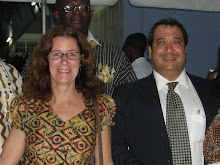
 At the end of the main ‘street’ was a room where all visitors sign in and meet either the chief himself or one of his sons who then sits with you and answers questions. (We got a son). The chief’s son was very open with us as he talked about education, life style, and health issues. We found out that there are 75 elementary aged children living in Nzulezo. Unfortunately, even though they have the 2 school rooms( I saw no evidence of any school supplies other than chalk and a blackboard-school wasn’t in session when we were there), they don’t have a steady teacher. The government can’t get anyone to come and live and teach here. Nancy kicked me and said under her breath, “Don’t even think about it!” We were asked for a small donation to the school to supplement the pay of a teacher who might agree to come.
 (Us with chief's son)
I noticed off of one of the side streets, because it was the dry season, a small patch of marshland that was uncovered and dried out enough to walk on. I saw a small soccer net and a few chickens walking around. 2/3 of the year that would be covered with water and there would be nowhere for the kids, or anyone for that matter to have any space to play or exercise. How do the chickens know not to wander off the docks?
As we saw how the people lived (without water/sanitation/easy access to the mainland) it got to be a little overwhelming. Although they can fish, most supplies, including water, have to be brought to the village by rowing to shore (45 minutes) and then taking the 30 minute walk to the nearest small town. I heard that some inhabitants have small plots of farmland in another village hours away that they tend to.
 I also asked about all of the young children I saw toddling about. “How do they keep them safe and from falling in the water?”
 “Oh”, our guide said, “When the baby is born the mother dips him in the water 3 times, then the water knows not to take the baby”. …
I'm leaving tomorrow for the states for 12 days to see Pamela graduate from UVA.
I'll be a long way from Nzulezo.




No comments:
Post a Comment